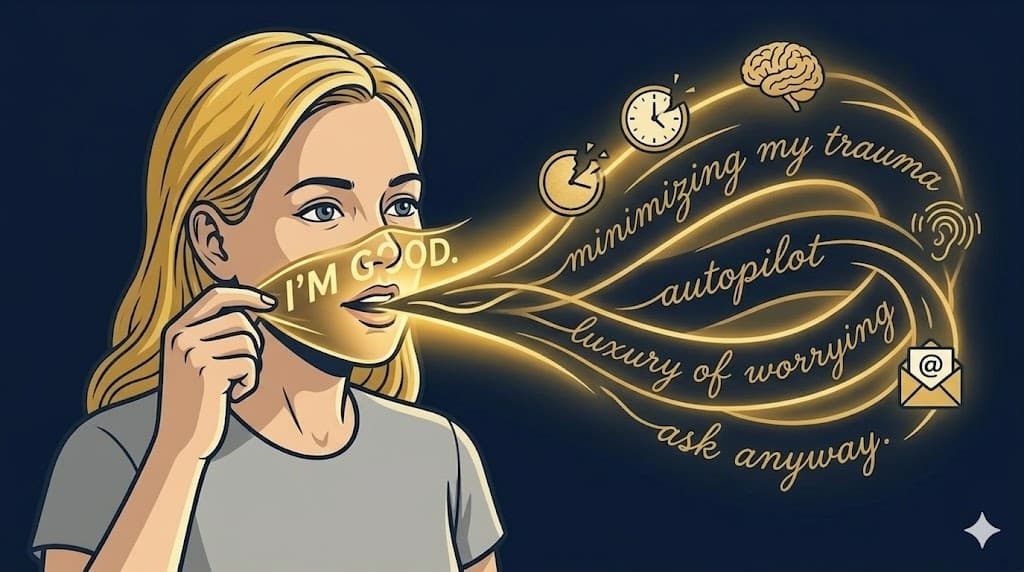
For years, I had a ten-second version of my story. I was running with my husband, the sun was in the driver's eyes, he hit me going twenty-five miles an hour, I was in a coma for seven days, and now I am here. It's all good. A blessing. I could say it without flinching, and then I would change the subject.
And when people asked how I was doing, the answer was even shorter. Good. Always good. I was on autopilot.
Why I kept saying it
The truth is that I did not feel I had time to fall apart. I was raising my boys, running a household, trying to look normal on the outside while a great deal was happening on the inside. It was go, go, go, all the time, and I never skipped a beat. In my mind, I did not have the luxury of worrying about myself. I wanted everything to be okay, so I said it was, over and over, until I half believed it.
I also pushed the accident to the back of my mind and minimized it. If I did not look at it too closely, maybe it would shrink down to something I could carry without anyone noticing.
What the minimizing cost me
Here is the problem with always saying you are fine. The people who could actually help you start to believe you.
I had a wonderful therapist after I left the hospital, someone with a real listening ear. After about a year, I decided I no longer needed her and I stopped going. The keyword there is decided, because I was wrong. I should have kept going. So should my husband and my family, who were carrying their own version of the trauma. By telling everyone, including myself, that I was good, I quietly closed doors that I needed to keep open.
The day I asked for help
It took me a long time to learn to say the harder, truer thing.
Years later, I was still struggling with how much noise and stimulation wore me down, and one day I finally sat down and emailed my doctor about it. I told him plainly what was happening. He wrote back and explained that it was most likely tied to the injury, and that I was already doing the right things by protecting my quiet. Such a small thing, one honest email, and yet comfort filled me up when I read his reply. It helped walk me back into life.
That was when it really landed for me. Ask for help, no matter the situation. Take away whatever fear you are feeling and ask anyway. It can only benefit you.
Say more than "good"
I have come to believe you have to be your own best advocate, because most of the time no one else will go up to bat for you. Looking back, I think good direction would have helped me so much in those years. Someone to help me see that "I'm good" was not a report. It was a reflex.
I am not a doctor, and this is not medical advice. It is just what I learned the long way around. The people on your team, your doctor, your therapist, your family, can only help with what they actually know. When you hand them "good," you hand them very little to work with.
A truer report
This is part of why the Sunrise app lets you keep an honest record and share it with the people in your care. When you have already written down how the days really went, the good ones and the hard ones, you do not have to summon it all from memory in a single moment, and you do not have to shrink it down to one safe word. You can simply show them the truth and let it speak.
You are allowed to be more than fine for other people. You are allowed to be honest, especially with the ones trying to help you heal.
References
Impaired self-awareness after traumatic brain injury: patient self-reports compared with significant others and clinicians. PMC4193327.
Feasibility of an interactive coaching app to enhance post-concussion outpatient care. PMC8757742.