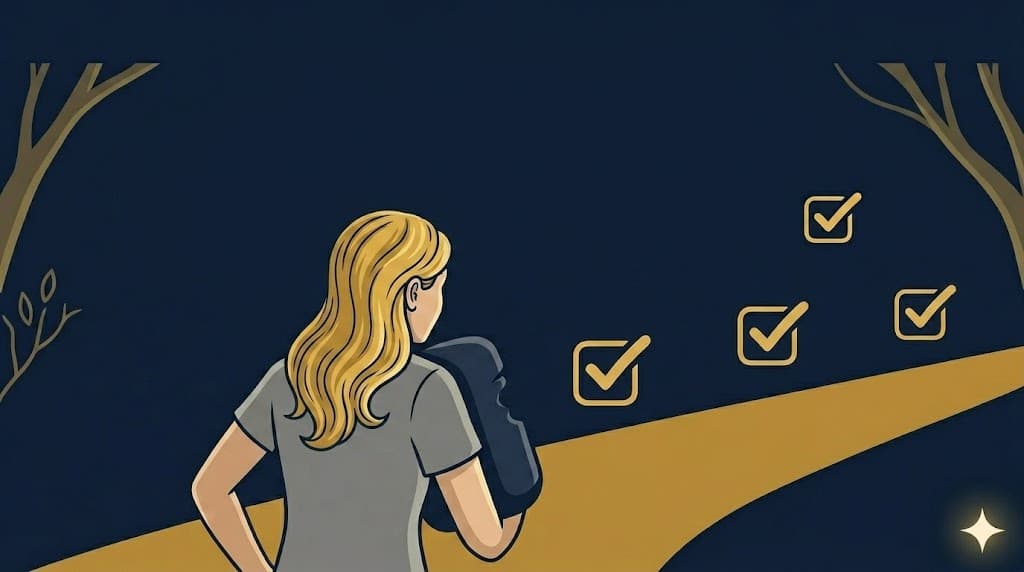
For a long time after my accident, I looked fine. I told everyone I was good, I smiled, I kept moving. From the outside, people thought I was back to normal, and honestly, I worked hard to seem that way.
What no one could see was the weight I was carrying underneath. A brain injury is often an invisible injury. The hardest parts of mine did not show up on anyone's face, including, for a while, my own.
A moment I will never forget
Early on, still badly hurt, I was propped up in a hospital bed when my family brought my little boy Jacob to see me. He was not even two. They set him down near me, and I wanted nothing in the world more than to pull him close.
I couldn't. My body would not let me. Broken ribs, a broken scapula, pain shooting down my arm, double vision. I lay there, propped up to look normal, and watched the little ones play, able only to smile from a distance. I was ambushed by a sadness I had never felt before, with zero control over any of it. That feeling was so foreign to me. To be a mother in the same room as her child, and not be able to reach him.
That is the invisible weight. It does not show on an X-ray. But it is as real as any broken bone.
The grief no one knew how to name
What made it heavier was that, for years, no one really talked about it. Not my family, not me. People meant well. They would ask how I was and then quickly change the subject, or fill the quiet with small talk, because no one knew what to say to someone who had been through what I had. There was no space to grieve it together.
So I did what a lot of us do. I pushed it to the back of my mind. I told myself I was lucky, which I truly was, and I kept looking forward. But underneath, I was quietly mourning the person I had been before. Grief like that does not stay buried forever. Mine surfaced years later, all at once, and I finally let myself feel it.
I want you to hear this part especially. If you are carrying something heavy that no one around you can see, it is not just you, and it is not weakness. It is one of the most common and least talked about parts of this whole experience.
Why I stopped hiding it
Looking back, one of my biggest regrets is stopping therapy after a year because I had decided I was fine. I was not. I have come to believe that mental health awareness is a must after a brain injury, for the survivor and for the family carrying their own version of the trauma.
I am not a doctor, and this is not medical advice. But I will say plainly what I wish someone had said to me. Please do not carry this alone. A good counselor or therapist can help in ways that white-knuckling it never will, and reaching out is a sign of strength, not the opposite. If the weight ever feels like too much, tell someone you trust, or a professional, today.
Making the invisible visible
One small thing that helps is simply naming how you feel. When a feeling stays vague and unspoken, it tends to grow in the dark. When you put a word to it, even just for yourself, it becomes something you can see, and eventually something you can share with the people who want to help.
That is part of why the Sunrise app gives you an easy, private place to note your mood alongside your day. Not to fix anything, and never as a replacement for real support, but as a gentle way to make the invisible a little more visible, one honest check-in at a time.
The weight is real. You do not have to pretend it away, and you do not have to carry it by yourself.
References
Bombardier CH, et al. Rates of major depressive disorder and clinical outcomes following traumatic brain injury. JAMA, 2010\. PubMed ID: 20483970\.
Model Systems Knowledge Translation Center (MSKTC). Depression after traumatic brain injury. msktc.org