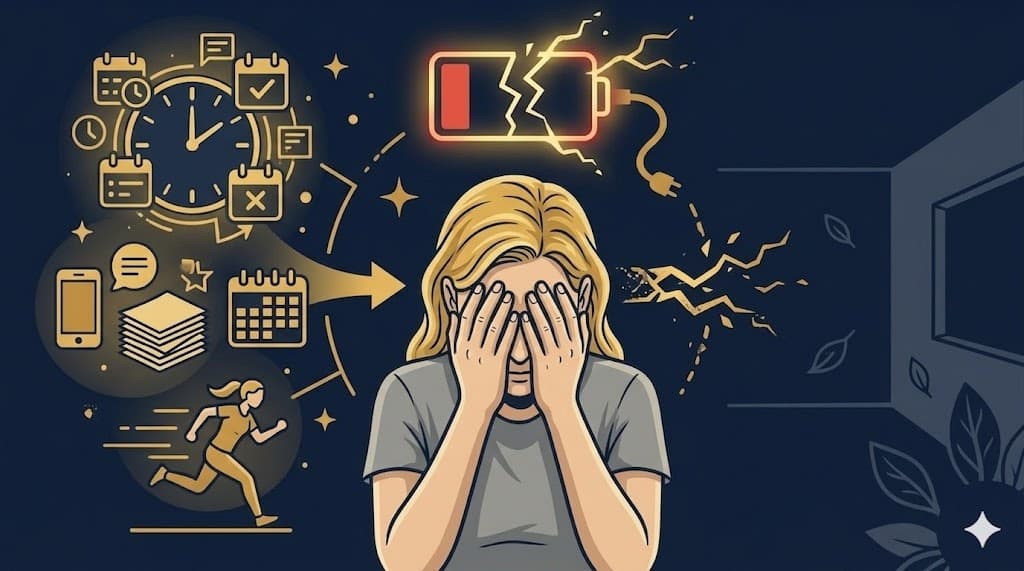
There is a kind of tired that sleep does not fix, and after my brain injury I came to know it well. It was not the honest tiredness of a long, good day. It was a deeper emptiness, like the tank was simply gone, often with no warning and nothing obvious to point to.
From the outside, I usually looked fine. I was good at looking normal while a great deal was happening inside. That is one of the hardest things about this kind of fatigue. Often no one can see it, sometimes not even you, until you have already run out.
A battery that drained faster
I came to picture my energy like a battery that no longer held a charge the way it used to. Ordinary things, a conversation, an errand, a noisy room, a busy afternoon, all pulled from the same limited supply. Tasks that once cost me almost nothing now cost me a great deal, and once the battery was empty, it was empty.
Understanding that did not make it disappear. But it helped me stop blaming myself for it. I was not weak or lazy. I was simply working with less, and spending it faster than I realized.
The boom and the crash
For a long time I handled this badly, because my instinct was the opposite of what my brain needed. I was a go, go, go person. I never skipped a beat. So on a good day, when I felt almost like myself, I would do everything. Say yes to all of it. Try to make up for lost time in a single afternoon.
And then I would pay. The good day would be followed by days of feeling flattened, sometimes needing to disappear into quiet just to recover. I lived in that cycle for years, a burst of doing followed by a hard crash, without ever seeing that the crash was simply the bill for the burst.
Pacing, instead of sprinting
What finally helped was learning to spread myself out instead of spending everything at once.
I learned to bow out and manage myself accordingly, a phrase I am almost proud of now, because it took me years to be able to do it. I learned that quiet time was not a reward for finishing everything first. It was something to build into the day on purpose, before the crash and not after. And I learned that saying no to one thing was often how I stayed standing for the next.
None of this came naturally to me. I had been a runner, someone who pushed through. Pacing felt like the opposite of everything I knew about myself. But a brain injury is a forever kind of thing, and I was not sprinting one race anymore. I was learning how to last.
I am not a doctor, and this is not medical advice. Your energy and your limits are your own, and only you can learn their true shape. This is simply what running on empty taught me, over and over, until I finally started listening.
Learning your own pattern
The tricky thing about this fatigue is how hard it is to see coming in the moment. It is much easier to recognize once you can lay your days side by side. What filled the tank, what drained it, which afternoons left you with nothing.
That is part of why the Sunrise app gently lets you note your energy along with the rest of your day. Over time, those small notes can show you your own pattern, so you can spend what you have with a little more care, and rest before the empty light comes on.
Be gentle with yourself about all of it. Running on empty is not a character flaw. It is a signal. And learning to pace, for me, was learning to honor it.
References
Dynamic prevalence of and factors associated with fatigue following traumatic brain injury: a systematic review and meta-analysis. PubMed ID: 37862135\.
Cantor JB, et al. Fatigue after traumatic brain injury and its impact on participation and quality of life. PubMed ID: 18219234\.