After my brain injury, I would walk into a room and forget why I came. A name would be there one second and gone the next. Someone would tell me something that mattered, and an hour later it was as if the conversation had never happened.
I was not being careless. From the day of my accident, and all through that first year, I battled memory loss, especially short-term. My mind, which I had always trusted, had become a place where things slipped through.
When you cannot even remember your own story
The hardest part came later, when I sat down to write about what I had been through.
I could not do it from memory alone. There were stretches of my own life, my own accident and recovery, that I simply did not have. So my friend Rachelle and I interviewed my family and friends to help fill in the blanks. People I love told me back the story of my own life, the parts I could not reach myself. I am grateful for it, and I will not pretend it was not humbling, to need other people to hand you your own memories.
That experience taught me something I have never forgotten, fittingly enough. If the mind cannot always hold things, then the things have to be held somewhere else.
The page became my second memory
For me, that somewhere else was writing.
I have always loved to write things down, partly for the comfort of it, but mostly to remember. A note is patient in a way my memory was not. It does not fade by the afternoon. It does not get crowded out by the next thing that comes along. Whatever I wrote down was still going to be there when I came looking, exactly as I left it.
So the page became a kind of second memory for me. Not a replacement for the one I was born with, but a backup. A place to set things down so they could not wander off.
Small things that helped me hold on
It was not only long journal entries. Some of what helped most was wonderfully ordinary.
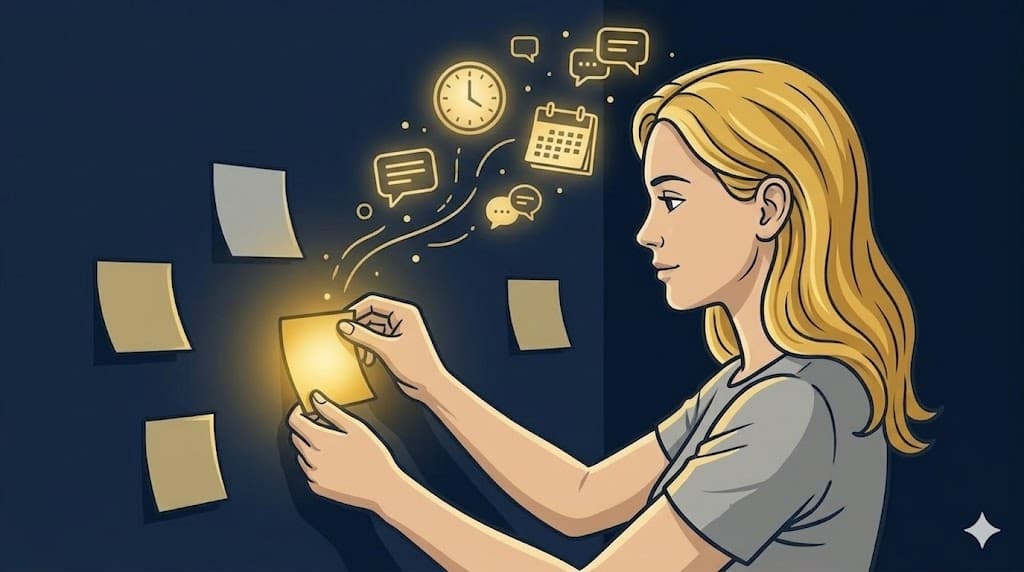
Sticky notes, everywhere, with reminders and cues for things I would otherwise lose. Alarms and timers on my phone for what I needed to do and when. A whiteboard with my days laid out, so I did not have to keep the whole schedule in my head. Reading things twice, so they had a better chance of staying. None of it was fancy. All of it was a way of letting something outside my mind carry part of the load.
I am not a doctor, and this is not medical advice. Memory after a brain injury is different for everyone, and only you and your care team can know what yours needs. This is simply what helped me when my own recall would not cooperate.
A place to set it down
If you love someone whose memory is not what it was, please understand that a written reminder is not babying them. It is a kindness. It hands the brain a little help instead of asking it to do something it cannot reliably do yet.
This is part of why the Sunrise app keeps a simple, lasting record of your days. Not to test your memory, but to spare it. What you note today will still be there when you go back to look, whether that is tomorrow, next month, or sitting across from someone who is trying to help you. You do not have to hold it all in your head.
Your mind is doing enough right now. You are allowed to let the page remember the rest.
References
Velikonja D, et al. INCOG recommendations for management of cognition following traumatic brain injury, part V: memory. Journal of Head Trauma Rehabilitation, 2014\. PubMed ID: 24984098\.
Cicerone KD, et al. Evidence-based cognitive rehabilitation: systematic review of the literature from 2009 through 2014\. Archives of Physical Medicine and Rehabilitation, 2019\.