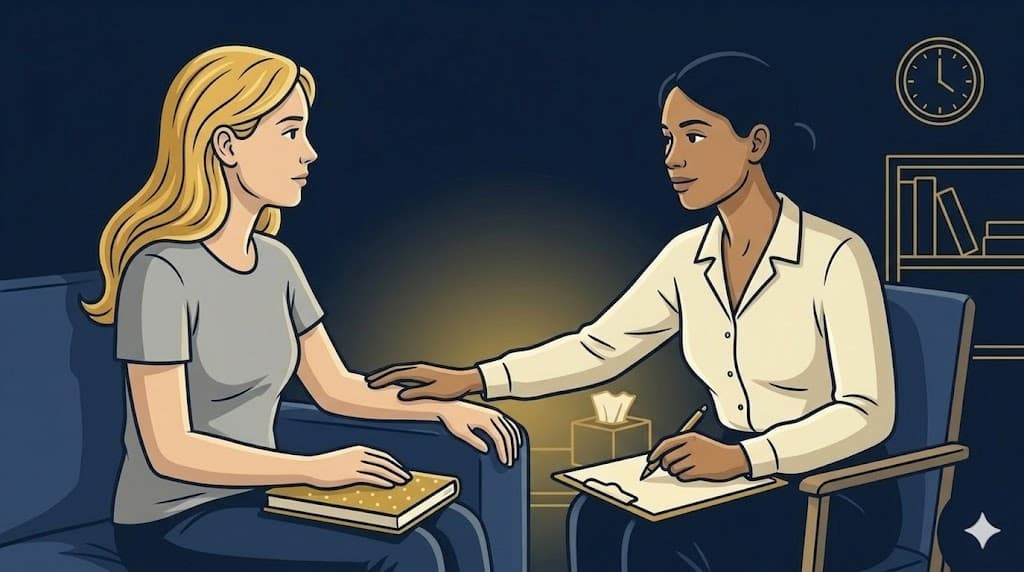
This one is not really for the survivors. It is for the people standing beside them. The husband, the wife, the parent, the sibling, the friend who keeps showing up. The ones who carry us when we cannot carry ourselves.
I want to talk to you for a moment, because I do not think you hear this enough.
It happened to you too
When I had my accident, everyone's eyes were on me, and rightly so. But a truth I have come to understand is that a brain injury does not happen to one person. It happens to everyone who loves them.
My family lived through their own version of the nightmare, and years later the marks were still there. My husband would not let me walk on the side of the road near oncoming cars. My younger sister still got nervous when I called from my husband's phone. For a long time, my loved ones avoided the restaurant we used to eat at before the accident. This was a traumatic experience for all of us, not only for me. If you are carrying someone, you are carrying something heavy too, and your pain is real even when everyone keeps asking only about theirs.
What you do matters more than you know
I want you to know that the small things you do are not small at all.
When I was in a coma, my family organized themselves into a rotation, taking turns at my bedside, up days and nights, talking to a body that could not answer. Raul held my hand, read to me, and prayed over me. My sister Pauline once saw the desperation in my eyes when I felt trapped in that hospital room, and she quietly wheeled me outside so I could feel the fresh air, even knowing she might get in trouble for it. None of them knew for certain whether any of it was reaching me. It was. Even the parts I cannot remember are woven into the fact that I am still here.
So if you are sitting beside someone right now, wondering whether your presence makes any difference, please believe that it does.
Please take care of yourself too
Early on, my family was told something wise that I wish all of us had taken more to heart. They were told that my recovery would be long, and that they would have to take care of themselves as well.
We did not fully listen. I stayed on autopilot. They kept going on empty. None of us tended to our own wounds, and that catches up with a person. So please hear me. You cannot pour from an empty cup, and running yourself into the ground does not help the one you love. Give yourself grace for this new normal. Rest when you can. And find your own support, a counselor, a friend, a group of people who understand, because the loss is real for you too, and your wellbeing matters every bit as much as the person you are caring for.
You will not always understand, and that is okay
There will be moments when you simply do not get it. When roofers once worked on our house and the noise overwhelmed me, my husband could not quite see why I was so undone, and my teenage son did not understand at all. To them, we needed a roof and the workers were doing their job. They were not wrong, and I could not always explain what was happening inside me either.
Understanding is a gift when it comes, but it is not the thing that matters most. Presence is. You do not have to fully understand the injury to sit with someone through it.
I am not a doctor, and this is not medical advice. This is really just a thank-you note, from someone who was carried.
For the ones who carry
This is part of why Sunrise includes a place for the people who support a survivor, and a way, when the survivor chooses, to share how they are truly doing. So you are not left guessing, and so you do not have to carry all of it alone either.
To every caregiver reading this, thank you. You are doing one of the hardest and most loving jobs there is. Please be as gentle with yourself as you are with the person you love.
References
Marsh NV, et al. Caregiver burden during the year following severe traumatic brain injury. Journal of Clinical and Experimental Neuropsychology, 2002\. PubMed ID: 12187457\.
Patterns of change and stability in caregiver burden and life satisfaction 1 to 2 years after severe traumatic brain injury: a Norwegian longitudinal study. PubMed ID: 27935561\.