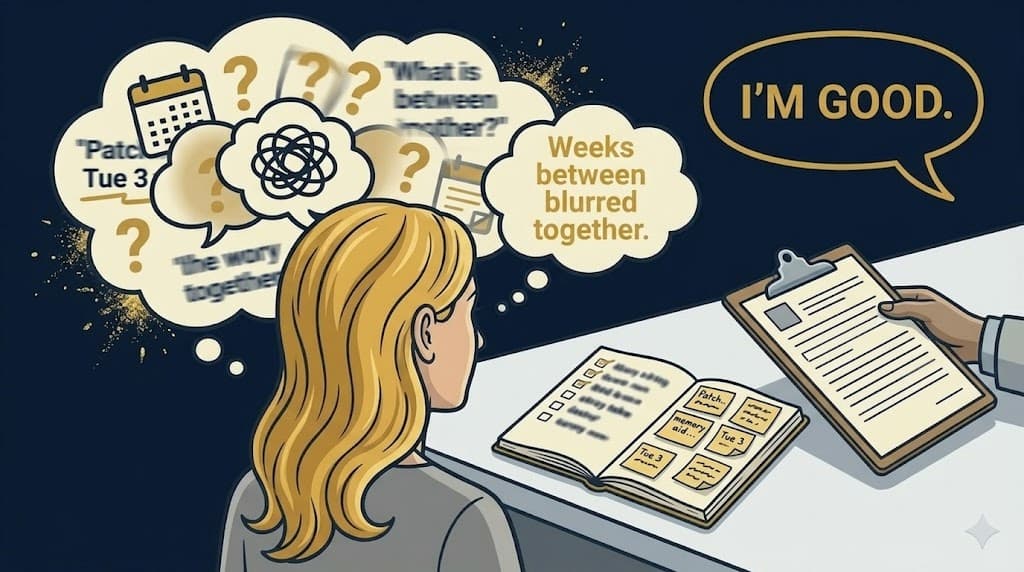
There is a question I came to dread a little. How have you been since I last saw you?
It is a kind question, asked by people who want to help. The doctor, the therapist, a family member checking in. And I wanted so badly to answer it well. But the honest truth was that I often could not. The weeks between visits had blurred together. The hard Tuesday three weeks ago, the better stretch after that, the rough patch I had meant to mention, all of it slipped away by the time I was sitting in the chair.
Why this is so hard after a brain injury
After my accident, especially that first year, I battled memory loss, particularly short-term. My recall simply could not be trusted to deliver the right details at the right moment.
It went deeper than appointments. When I later sat down to write my own story, I could not reconstruct large parts of it from memory at all. My friend Rachelle and I had to interview my family and friends to fill in the blanks of my own life. So when someone asked me to sum up weeks of recovery on the spot, of course it came out as a vague "I'm good." Not because I was fine, but because "good" was all I could reliably reach for.
The trouble is that the people trying to help you can only work with what you actually tell them. When memory hands them a blur, they end up guessing too.
What finally helped
What changed things for me was writing it down as it happened.
When I kept a simple record of my days, the good and the hard, I no longer had to summon weeks of memory in a single moment. I could read from notes I had made when it was all still fresh. The appointment stopped being a memory test I was destined to fail, and became a conversation grounded in something real.
I saw the power of this clearly one day when I was struggling and finally wrote my doctor a plain, honest email describing exactly what was happening to me. Putting it in writing did what my in-the-moment memory never could. He understood, he wrote back, and I got the reassurance and direction I needed. The simple act of writing it down got me help.
A note to the doctors, therapists, and families
If you are the one on the other side of that question, this part is for you.
When a patient with a brain injury says "I'm good," it is often not the whole story. It may be all their memory can produce in that moment. A patient who keeps a simple record, and chooses to share it, can hand you a far fuller and more accurate picture of how the weeks actually went. It is not a medical chart, and it does not diagnose anything. It is simply the person's own honest account, captured while it was fresh, which can make the time you have together far more useful.
I am not a doctor, and this is not medical advice. I only know what it felt like to want to report the truth and not be able to find it.
Why this matters to us
I will be honest about one thing as I close. This exact problem, wanting to tell my care team the truth and being failed by my own memory, was one of the most important reasons the Sunrise journal exists.
Your memory is doing enough right now. Letting the page hold the details means that when someone asks how you have really been, you will have a true answer ready, in your own words, from the days you actually lived.
References
Recall of traumatic brain injury events: reliability of self-report. PubMed ID: 27265159\.
Self-reported cognitive symptoms and neuropsychological performance after traumatic brain injury. PubMed ID: 20848365\.