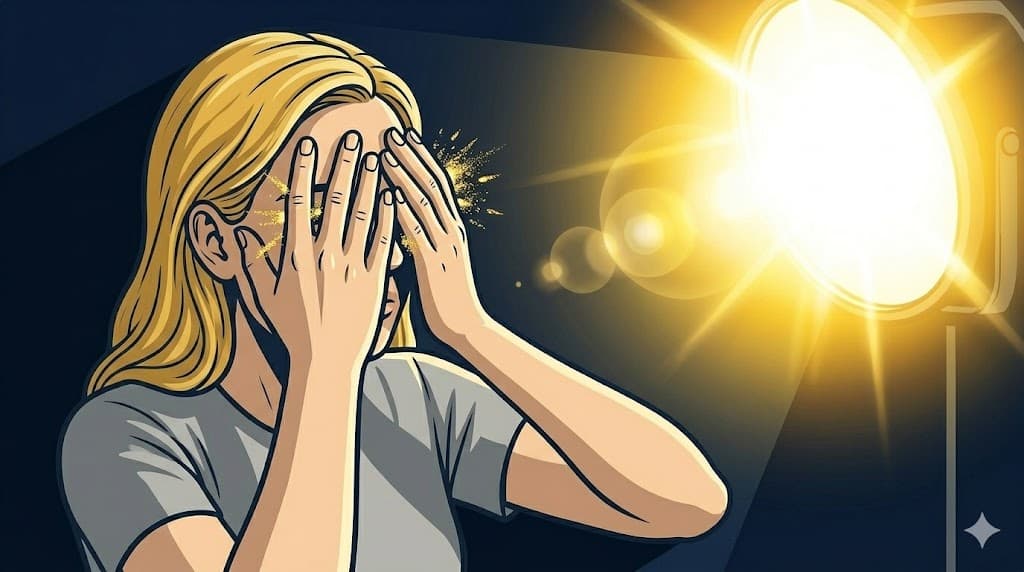
There was a gym I used to go to with a friend. Bright lights overhead, pop music turned all the way up. One day I was moving between the treadmill and the weights when the lights and the noise caught up with me all at once. The glare was too much for my eyes, and by the time I drove home I felt like something thick and slow swirling down a funnel. I got into bed and stayed in silence for two days.
After my brain injury, ordinary places could do that to me. Things I had walked through a thousand times without a thought now carried a cost.
It was never only my eyes
The light was part of it, but it was bigger than that. A bright, loud, crowded room seemed to pour in faster than I could keep up with.
I once lasted about thirty minutes at a birthday party at an arcade before I had to leave. Flashing neon, blaring music, machines dinging from every direction. It felt like my forehead was being crushed. I went and sat alone in the car in the empty parking lot. I only wanted to do normal things, like everyone else, and sometimes my brain simply would not let me.
When the people around you cannot see it
Some of the hardest moments were the ones other people could not see.
One day, roofers worked on our house and banged away for hours. It set the dogs barking and set my nerves on fire. I told my husband it was all too much for me to handle, and I could see on his face that he was not sure what to make of it. My teenage son did not understand why I was upset either. To him, we needed a roof and the workers were doing their job. They were right. And I still had to retreat to a dark, quiet room and let Enya's calm music carry me until it was over.
If you love someone who is healing, please know this. When they say a room is too much, or they need to step out, or to lie down in the dark, they are usually not being dramatic. They are protecting something real.
Quiet is not weakness
For a long time I felt like a party pooper for needing these things. I would push through the bright and the loud because I thought that was what strong people did, and then I would pay for it.
What I believe now is simple. A person healing from a brain injury needs quiet time. For me it was not a mood or a luxury. It was a must. And I had to learn to be my own best advocate, because most of the time no one else is going to go up to bat for you on this.
I am not a doctor, and none of this is medical advice. When I finally asked mine about it, he told me the sensitivity was most likely tied to the injury, and that the real relief was simply to step away from the triggers when I could. Asking for that help, instead of suffering through, made all the difference.
Building calm into what I use
Once I understood what my senses needed, I started shaping my surroundings to match. Softer light. Fewer things competing for my attention.
That is the thinking behind how the Sunrise app looks and feels. Deep, soft colors, low glare, calm and steady screens with nothing jumping around. It was made for tired eyes and busy brains, so that opening it feels more like a quiet room than a loud one.
A gentle space, when so much of the world is not, can make a real difference. Mine did.
References
Merezhinskaya N, et al. Photophobia associated with traumatic brain injury: a systematic review and meta-analysis. Optometry and Vision Science, 2021\. PubMed ID: 34354013\.
Callahan ML, Lim MM. Sensory sensitivity in traumatic brain injury: implications for chronic disability. Current Neurology and Neuroscience Reports, 2018\.